The Solopreneur's Real Problem (It's Not Productivity)
You have read the productivity articles. You have tried the apps. And you are still the person who answers the phone, writes the proposals, does the research, manages the inbox, and somehow finds time to actually deliver the work clients paid for.
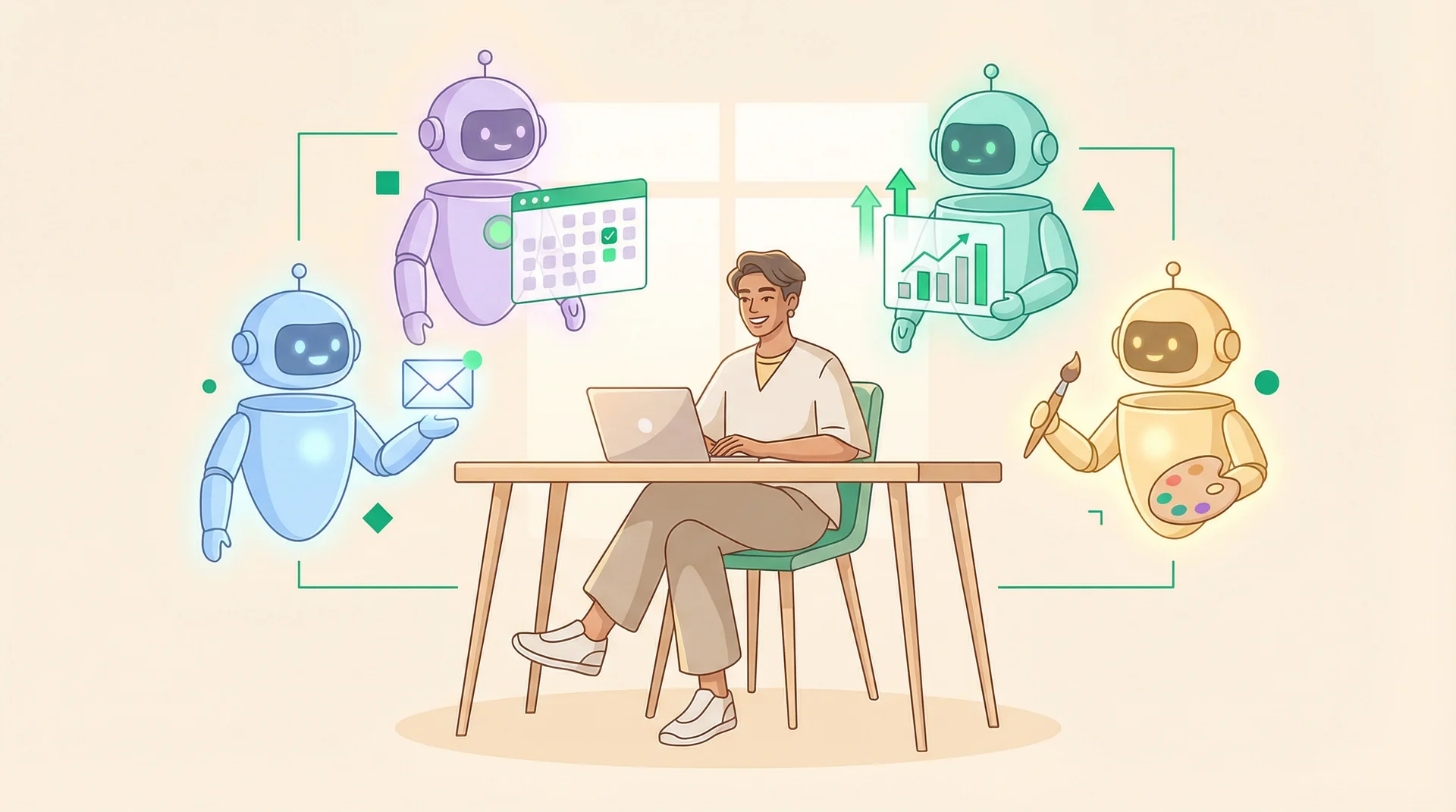
The problem is not that you are unproductive. The problem is that you are doing work that doesn't require your specific skill.
When a potential client calls while you are in a session with someone else, you miss the call. When you need to research a prospect before a discovery meeting, that 90-minute prep eats directly into billable time. When a social post needs writing, it goes on the list and the list never gets shorter.
None of that work is strategic. But all of it has consequences if it doesn't happen. That is the solopreneur trap: the operational work is not optional, but doing it yourself is the most expensive way to get it done.
AI workers handle the work that doesn't need you. You focus on the work only you can do.
The First Hire: Your AI Receptionist
If you could only add one AI worker to your business, start here.
An AI Receptionist answers every inbound call — in your brand voice, with the information about your services, available 24 hours a day. It qualifies the caller (is this a real prospect or a time-waster?), books discovery calls directly into your scheduling tool, and sends a follow-up message confirming the appointment.
While you are in a client session, your AI Receptionist is talking to the next client. While you are asleep, it is booking calls for the morning. When a lead calls from a timezone where it is 2 AM for you, they get a response — not a voicemail and a 16-hour wait.
When you are in a client session or deep in delivery work, inbound calls go unanswered. For solopreneurs without staff, every missed call is a potential missed client. If you charge £500 for a discovery-to-project conversion, and you miss two calls a week that would have converted at 1 in 4, that is £13,000 in annual missed revenue. An AI Receptionist at a fraction of that cost is not a technology expense — it is a revenue recovery decision.
What you need to set it up: Your service description, your calendar link, your booking tool (Calendly, Cal.com, Google Calendar — all connect natively).
Time to configure on AgentsHub: Under 30 minutes.
The Second Hire: Your AI Research Analyst
Walking into a client call unprepared is the fastest way to lose trust in a solopreneur business. Clients can tell when you haven't done your homework. They also remember when you have.
An AI Research Analyst handles the preparation work you don't have time for. Brief it with a client name and meeting date, and before the call it has already pulled the company's recent news, their key executives, their competitive position, and any relevant industry developments — all organised into a one-page briefing note in the format you specify.
It also runs in the background between calls. Set it to monitor your industry sector, a handful of competitors, or the publications your clients read — and receive a weekly digest of what changed and why it matters for your positioning.
The time return is not marginal. Research preparation that takes 90 minutes manually takes under 5 minutes when you are reviewing a pre-built brief rather than building it yourself. At three client prep sessions per week, that is 4.5 hours back — every week.
What you need to set it up: A list of information sources, your preferred brief format (paste a sample into the knowledge base), and your calendar integration so the agent knows which calls are coming up.
The Third Hire: Your AI Content Writer
Every solopreneur knows they should be more consistent about content. Most aren't, because content takes time they don't have and mental energy they've already spent on client work.
An AI Content Writer drafts newsletters, social posts, and blog outlines from a brief you write in two minutes. It learns your brand voice through the system prompt — the specific language patterns, positions, and tone that make your writing yours. It does not write for you. It drafts, and you direct. The difference is whether you spend 90 minutes staring at a blank page or 15 minutes editing a solid first draft.
Connect it to Notion and your drafts are automatically stored in your content workspace. Connect it to your email tool or social scheduler and it handles the delivery step as well. The 30-minute task becomes a 10-minute task.
What you need to set it up: 3–5 examples of your existing content (paste into the knowledge base), your publishing schedule, and the tools you use to publish.
Connect to Gmail for newsletter distribution or your social scheduler for post publication — AgentsHub handles the delivery without a separate integration step.
How These Three Work Together
Individually, each of these workers saves time. Together, they create something more valuable: a workflow that operates independently of your availability.
Here is a concrete scenario. You are in a 2-hour workshop with a client on a Tuesday afternoon. At 2:47 PM, a prospective client calls — someone who found you through a referral and wants to discuss a project that would be your largest engagement of the quarter.
With only yourself: the call goes to voicemail. You see it at 5 PM, call back, get voicemail. The prospect calls someone else on Wednesday.
With your AI workforce:
- AI Receptionist answers at 2:47 PM. Asks about the project, budget range, and timeline. Recognises this as a strong lead. Books a Thursday morning discovery call directly into your calendar.
- AI Research Analyst receives a trigger from the booking and begins preparing a brief on the prospect's company — their recent funding, their team size, the work they've posted publicly, and any news in the past 90 days.
- You wake up Wednesday morning to a calendar invite and a one-page brief on a prospect you've never spoken to. Thursday's call starts with you knowing exactly who they are and what they're likely to need.
That is a four-person workflow. You were one person. The prospect had an experience that felt like talking to a professional, organised team — because functionally, they were.
What AI Workers Can't Do (Yet)
Being honest about limitations builds more trust than overpromising. There are things your AI workforce will not replace, and you should know them before you start.
- Your relationships. The network you have built, the reputation you carry, the personal trust clients place in you specifically — that is yours. An AI worker can help you show up better in those relationships. It cannot replace the relationship itself.
- Novel legal or financial decisions. If a client contract has an unusual clause, if a tax situation is ambiguous, if a dispute requires judgment about what is fair — those decisions belong to humans. Configure your AI workers to escalate these, not resolve them.
- Your creative direction. An AI Content Writer drafts. You direct. The voice in the draft is shaped by your examples and your system prompt, but the judgment about what to publish and how — that is yours. AI workers are a production tool, not a creative substitute.
- Negotiations requiring your personality. The final conversation with a client about price, scope, or a difficult situation — that is a human conversation. Your AI workers can prepare you for it. They cannot have it for you.
Getting Started: The 30-Day Solopreneur AI Plan
Trying to set up all three workers simultaneously is the most common way to set none of them up properly. Configure one at a time, measure what changes, then add the next.
Week 1 — AI Receptionist: Configure, connect your calendar, and let it handle all inbound calls for one week. At the end of the week, check: How many calls were answered? How many were booked as discovery calls? How many of those callers would have gone to voicemail without the worker? That number is your week-one ROI data point.
Week 2 — AI Research Analyst: Add the research worker. Use it to prepare for three client or prospect calls. At the end of the week, assess whether the quality of those conversations was different — and how much time you saved. Most people who do this genuinely cannot go back to manual prep.
Week 3 — AI Content Writer: Add the content worker. Use it to draft four pieces of content — two short (social posts or newsletter blurbs) and two long (a newsletter or blog outline). Review the drafts, make corrections, and update the system prompt based on what felt off. By the third draft, the voice alignment is usually strong enough to cut editing time by half.
Week 4 — Connect the three: Run one complete client workflow end-to-end through your AI team. New lead calls → AI Receptionist books the call → AI Research Analyst preps the brief → you show up informed → AI Content Writer drafts a follow-up case study or proposal outline after the call. At the end of week four, you will have a measurable answer to the question "what does this actually change?"
Start with one. The solopreneur use case page shows the full picture of what a solo operation looks like with an AI workforce in place.
For context on how this fits into the broader picture of AI workforce platforms, read: What Is an AI Workforce? A Plain-English Guide.