The Three Generations of AI at Work
Before you can understand what an AI workforce is, you need to understand what it replaced — and why each generation fell short of what businesses actually need.
Generation 1: Chatbots
Chatbots arrived in business software around 2016. Their job was simple: handle FAQ traffic, route support tickets, and suggest knowledge base articles. They were useful for this narrow purpose. They are still useful for it today.
What they cannot do: make decisions, take actions, remember context across sessions, initiate contact, or handle anything outside their predefined script. A chatbot is reactive by design. It waits for a prompt. It produces a response. That's the end of the transaction.
Examples include Intercom Fin, Zendesk Answer Bot, and older versions of Drift. The technology is mature and well-understood. It is also, increasingly, the floor — not the ceiling.
Generation 2: AI Agents
AI agents emerged from the large language model boom of 2023–2024. Unlike chatbots, agents can plan. They can reason across multiple steps. They can use APIs and tools, browse the web, and complete complex tasks that no rigid decision tree could handle.
What agents still cannot do: hold a consistent job role over time, speak on the phone with a customer, work as part of a team without custom engineering, or be deployed without developer involvement. Frameworks like CrewAI, AutoGen, and LangGraph are genuinely powerful. They all require Python. They all require a skilled engineer to configure, maintain, and debug them in production.
This created a paradox: the technology was sophisticated enough to do meaningful work, but the deployment barrier was high enough that most businesses couldn't reach it.
Generation 3: AI Workers
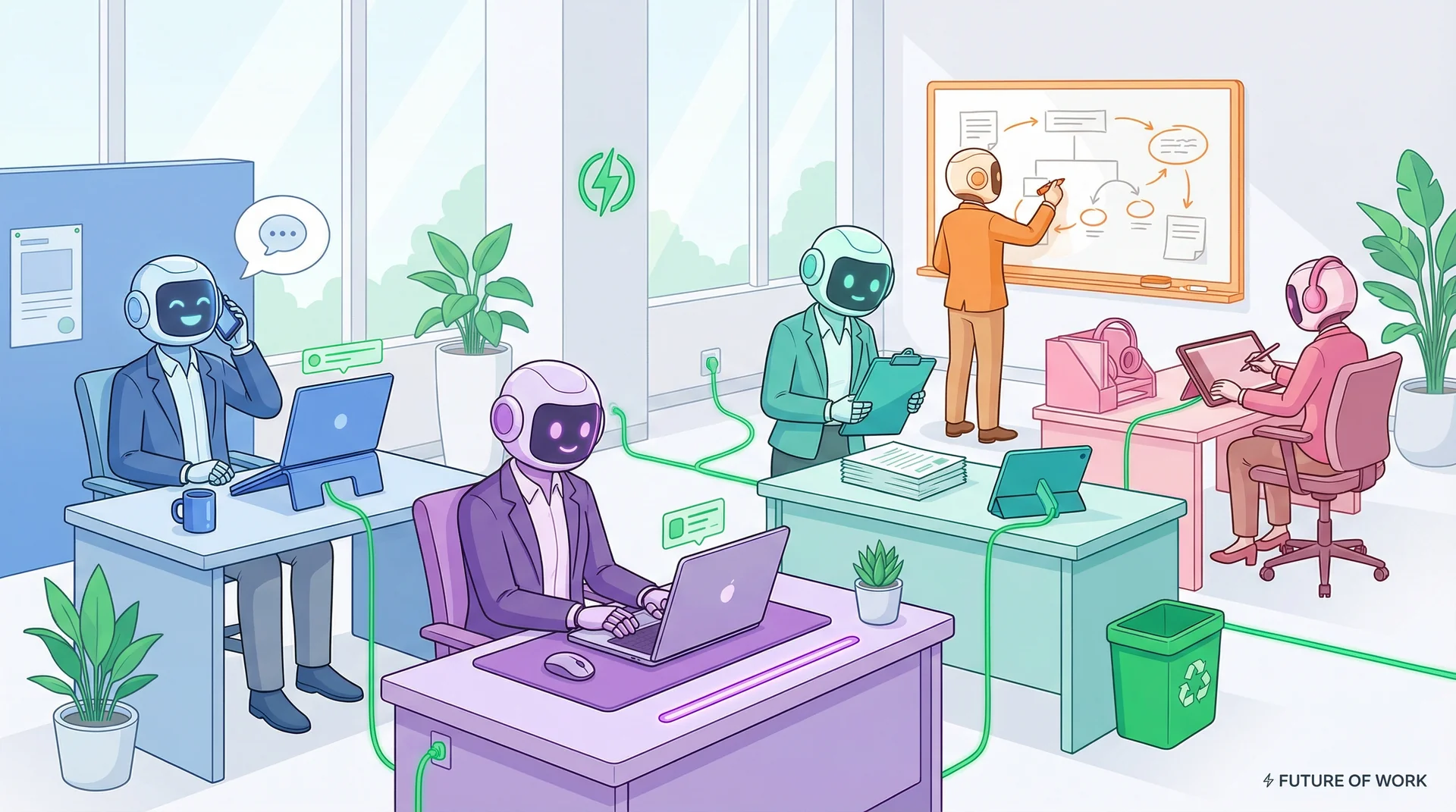
An AI worker is a role-based AI system — one that holds a job title, has access to the tools that job requires, can speak on the phone, can hand tasks off to colleagues, and operates independently across multiple communication channels simultaneously.
This is what an AI workforce is built from. Not chatbots. Not one-off agents. Role-defined, tool-equipped, voice-capable digital employees — deployed together, coordinated by a visual orchestration canvas, and connected to your existing business stack without a line of code.
What Makes an AI Worker Different from an Agent
The distinction between an AI agent and an AI worker is not semantic. It is architectural.
- Role definition: An AI worker begins with a job title and a system prompt that functions like a job description. "AI Sales Development Representative" is not a label — it is a behavioral contract. The worker knows what it owns, what it escalates, and what is outside its scope.
- Tool access at job scope: A real sales rep uses Salesforce, LinkedIn, and email. An AI SDR uses the same tools — logging calls, updating records, sending sequenced outreach, and booking calendar appointments — via hundreds of native integrations that require no custom API work.
- Voice and a real phone number: AI workers can answer and make phone calls using a built-in voice engine with support for 10+ languages and regional accents. An AI Receptionist picks up inbound calls, qualifies leads, and books appointments — in natural speech, in the caller's language, 24 hours a day.
- Organisational knowledge: Each worker is trained on your company's documents — pricing sheets, product specs, support runbooks, compliance policies — so their responses reflect your organisation, not a generic model's training data.
- Escalation paths: An AI worker knows when to hand off. It knows the difference between a task it owns and a case that requires human judgment. This is not a workaround — it is a design principle. The best AI workforces are not fully automated. They are intelligently augmented.
What an AI Workforce Looks Like in Practice
Abstract definitions only take you so far. Here is a concrete example using a hiring workflow — the canonical illustration of what coordinated AI workers make possible.
A company receives 200 job applications for a single role. Here is how the workflow runs with an AI workforce:
- AI Sourcing Agent reviews all 200 applications against the role criteria, ranks them by fit, and flags the top 40 for screening. Time: 12 minutes.
- AI HR Screener calls each shortlisted candidate, conducts a structured phone interview, and transcribes responses into the ATS. Time: automated overnight.
- AI Scheduler books panel interviews for the top 15 candidates directly into the hiring manager's calendar, accounting for timezone and preference constraints.
- Human Hiring Manager joins the process at the final conversation stage — equipped with a briefing note produced by the AI Sourcing Agent.
The human's time is spent entirely on the judgment work. The AI workforce handles everything that doesn't require it. This is not future-state. This is deployable today on AgentsHub using roles from the visual orchestration canvas.
Who Builds AI Workforces — And Why
Enterprise teams augmenting headcount at scale
Enterprise operations leaders use AI workforces to handle volume that headcount cannot absorb economically. Randstad — the global talent and workforce company — deploys AgentsHub across 30 countries. At that scale, consistency and coverage are not achievable with human teams alone. AI workers provide both. See the enterprise use case for detail on how large organisations structure their AI workforce deployments.
Startups doing more with the team they have
Startup founders deploy AI workers because they cannot yet afford the human roles they need. An early-stage company can deploy an AI SDR, an AI support agent, and an AI research analyst in an afternoon — covering three full-time roles at a fraction of the hiring cost. Explore the full library of 35 AI worker roles.
Solopreneurs running multi-person operations alone
The fastest-growing segment for AI workforces is solopreneurs — individual operators who use AI workers to function like a small team. A consultant can have an AI receptionist handle inbound, an AI researcher prep client briefs, and an AI writer draft deliverables — while they focus on the work only they can do. See the solopreneur use case.
Developers building production multi-agent systems
For engineering teams, AgentsHub provides an API-first deployment layer for multi-agent systems that would otherwise require months of custom infrastructure. See the developer documentation for API reference and embedding options.
The Business Case: What Does an AI Workforce Cost?
Industry analysts project the AI agents market will grow significantly through 2027, driven by enterprise demand for autonomous task execution. A growing share of enterprise applications are expected to embed task-specific agents as organisations move beyond pilots into production deployment. These are not incremental additions to existing tech stacks — they represent a structural shift in how work gets done.
The cost comparison is not "AI worker vs. software licence." It is "AI worker vs. full-time employee." A single AI worker can handle tasks that would otherwise require two to three FTEs in high-volume, rule-governed work categories — without attrition, without onboarding time, and without geographic constraints.
That said, no honest ROI calculation is straightforward. AI workers have real setup costs (knowledge base configuration, prompt tuning, integration testing) and real failure modes (novel situations, edge cases, judgment calls). The business case depends on the role, the volume, and the clarity of the task definition. For a detailed framework, see our guide to the real ROI of AI workers.
AgentsHub connects directly to Salesforce, HubSpot, Notion, and hundreds of other tools your team already uses — meaning there is no migration cost, no data re-entry, and no parallel system to manage.
Common Misconceptions About AI Workforces
Several objections appear consistently when organisations first evaluate AI workforce platforms. Most are based on how the technology worked two or three years ago.
- "It's just automation." Automation executes predefined scripts. AI workers make decisions — they interpret ambiguous inputs, handle exceptions, and adapt to context. The distinction matters when the real world doesn't follow the script.
- "You need developers to build and maintain it." Frameworks like CrewAI require Python and ongoing engineering maintenance. AgentsHub does not. Role creation is done by job description, not code. Orchestration is drag-and-drop on a visual canvas.
- "It's about replacing human workers." The organisations seeing the best results use AI workers to handle the volume, consistency, and after-hours work that human teams cannot sustainably cover — freeing people to do the higher-judgment work they were hired for. Augmentation, not replacement, is both the honest framing and the more effective deployment strategy.
- "It's only viable for large enterprises." The cost curve for AI workforce platforms has inverted. In 2026, a solopreneur can deploy three AI workers for less than the cost of a single software subscription. The ROI equation works at every company size.
How to Start Building Your AI Workforce
The most common mistake when building an AI workforce is trying to automate everything at once. The organisations that succeed start small, measure precisely, and expand from proof.
- Identify one role with predictable, measurable output. The AI Receptionist and AI Research Analyst are the lowest-friction starting points — high volume, clear success criteria, easy to measure before and after.
- Configure and run for 30 days. Treat the first month as a calibration period. Adjust the system prompt, refine the knowledge base, and observe where the AI worker succeeds and where it escalates. Every escalation is a data point for improvement.
- Add orchestration as you add roles. The value of a workforce multiplies when workers coordinate. Start with two workers connected in sequence (receptionist passes qualified leads to support agent). Expand from there.
The AI Receptionist is ready to configure in under 30 minutes. Start with one worker. Measure what changes. Build from there.
Explore all 35 AI worker roles — or start building your AI workforce free on AgentsHub today.